
Suncream works. It lowers your risk of skin cancer and slows visible ageing, and that has been shown in proper randomised trials, not just hunches. Yet the same myths keep going round: that suncream causes cancer, that the chemicals mess with your hormones, or that a tan means you are covered. On an episode of the Healthcast, a doctor went through these claims one by one. Here is the honest version: what holds up, what SPF you actually need, how often to reapply, and where a tan and vitamin D fit in.
The short version
Suncream genuinely reduces the risk of skin cancer and slows down skin ageing. That is not marketing, it has been shown in Australian studies, including randomised ones where people did not know whether they were getting the real product or a dummy.
For everyday use, SPF 30 is fine. If you are actually spending the day in the sun, SPF 50 or higher is the sensible choice. Apply enough (roughly a shot glass for your whole body) and reapply, especially after swimming.
A tan gives only a small, temporary bit of protection. And suncream does not cause skin cancer. If anything, the opposite is true.
What the sun actually does to your skin
The sun sends radiation out in all directions. Part of it is ultraviolet light (UV), which sits just beyond the violet end of the spectrum, so you cannot see it. It carries a lot of energy, and anything with that much energy can break things.
There are three types of UV. UVC is absorbed by the atmosphere, so it never reaches you. UVA and UVB both hit your skin. A rough memory aid from the episode: UVA for ageing, UVB for burning. It is not perfectly exact, but it points you in the right direction.
UV can damage the DNA in your skin cells. Damaged DNA can mutate, and over time that can lead to skin cancer. On top of that, UV visibly ages your skin. The classic example is lorry drivers whose window-side cheek looks years older than the other, purely from sunlight coming through the side glass.
Myth 1: suncream causes skin cancer
This is probably the most stubborn claim, and it does not hold up. It comes from a simple mix-up: people who use suncream more often also get skin cancer more often. But that is because they spend more time outdoors and therefore catch more sun in the first place.
As the doctor put it, associations are not the same as cause and effect. You only see what the cream itself does when you compare two groups with the same sun exposure. That is exactly what the Australian randomised studies did: one group got real suncream, the other a dummy, without knowing which.
The result was that the risk of all three types of skin cancer went down. For the two most common types the evidence is very strong. For melanoma the data is also convincing enough to say the risk falls.
We have been using more suncream over the past few decades, but we have also taken far more sunny holidays. Skin cancer rates going up is down to that extra exposure, not the cream.
Myth 2: the ingredients in suncream are bad for you
There are broadly two kinds. Chemical suncreams use organic compounds that absorb UV light. Mineral ones use zinc oxide or titanium dioxide instead.
For a long time the line was that almost none of a chemical suncream gets into your blood. A study showed that is not quite true: a few per cent of some ingredients is absorbed. That fairly raised some questions.
So researchers then checked, ingredient by ingredient, whether those amounts actually disturb your hormones or metabolism. The answer was no. The ingredient with the highest absorption, oxybenzone, was measured in people who applied it every two hours for three days straight. Even then the peak level was still five to six times below the point where any disruption would be plausible. That is a comfortable safety margin.
If you still want to be completely sure, go for a mineral suncream with zinc oxide or titanium dioxide. Regulators are clear that those are safe. You have to look a bit harder for them, and they can leave a slightly whiter cast on the skin, but there are good ones where that is barely noticeable.
Myth 3: if I am tanned, I am protected
A tan does offer some protection, but less than you would hope. Think about how you got tanned in the first place: through UV exposure. Your body makes more melanin, which absorbs some of the UV, and your skin also thickens a little.
But it is temporary. After your skin sheds a few times it is gone again. So you have already taken a fair amount of radiation just to build a thin layer of protection that does not even last. In SPF terms, a tan is roughly the difference between factor 3 and factor 5. Not much.
So do not talk yourself into feeling safe just because you have a bit of colour.
Myth 4: darker skin does not need suncream
Your skin type does matter. The Fitzpatrick scale runs from 1 (very fair, burns quickly) to 6 (very dark). The skin’s natural level of protection ranges from roughly SPF 0 to 15.
So even the very darkest skin type sits around SPF 15, meaning it takes about fifteen times longer in the sun to get the same damage. That helps, but UV damage still gets through, and skin ageing still happens.
If you have fair skin and burn quickly without tanning (often type 1), that is exactly when you need to be most careful.
Myth 5: clothes, clouds and glass block it completely
All of them only partly. A thin T-shirt is about SPF 5. Proper sun-protective clothing can reach SPF 50 or 60, but even that is not a full block.
Clouds do not keep you safe. A cloudy day lets through less visible light, but most of the UVA, the ageing radiation, comes straight through.
Glass mainly blocks UVB, not UVA. Behind glass you will not burn or tan, so it feels safe. But the UVA that causes damage and ageing still gets through. Which brings us back to those lorry drivers.
How to use suncream properly
SPF tells you how much it slows your exposure down. With SPF 60, an hour in the sun gives you roughly the same UV as one minute without protection, provided you apply it well. And layering three lots of factor 30 does not make factor 90, that is not how it works.
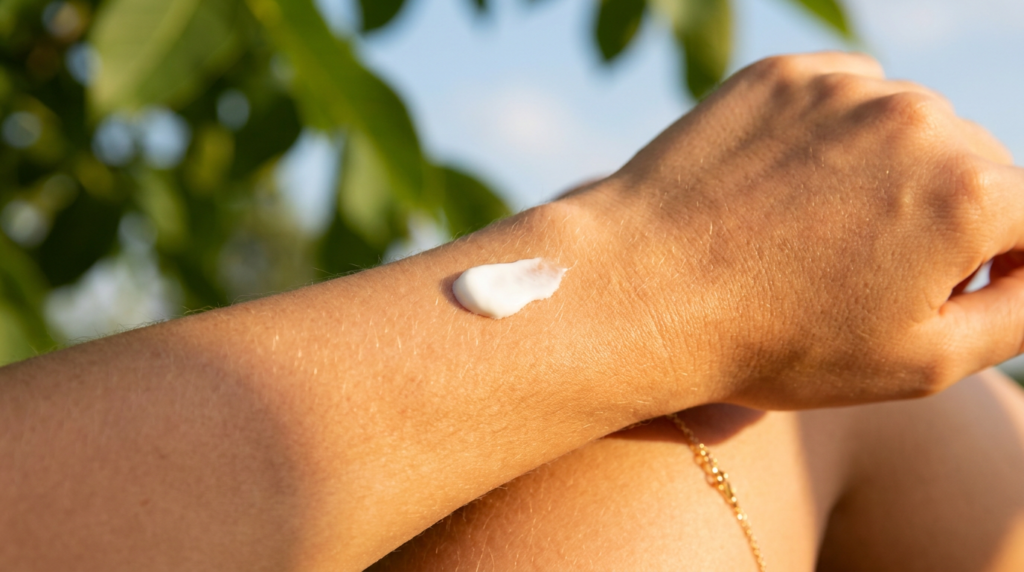
The biggest mistake is using too little, too rarely. For your whole body, reckon on about a shot glass (around 30 ml), often described as seven teaspoons. Timing matters too: if you only apply it once your towel is down on the beach, you are already late, because the walk from the car counts.
Be wary of waterproof claims as well. They are often tested with someone sitting still in a bath for sixty minutes. In real life you swim, splash about and towel off. So reapply after you have been in the water.
The doctor now applies it every day, even in winter, simply because that way it is part of the routine. Practise what you preach.
Frequently asked questions
What SPF do I need for everyday use?
For most days SPF 30 is fine. If you are really going to be in the sun, for example on the beach or outdoors all day, SPF 50 or higher gives you good protection. Because people apply too little on average, it is sensible to go a bit higher than you think you need.
How much and how often should I apply it?
For your whole body, reckon on about a shot glass, roughly 30 ml, often described as seven teaspoons. More important still is reapplying: put more on after swimming or towelling off, and keep topping it up through the day. Most people use enough the first time but forget to reapply. And apply before you go into the sun, not once your towel is already down.
Can you still tan with suncream on?
Yes, you still tan, just more slowly, because suncream slows UV exposure rather than blocking it completely. Bear in mind that tanning means UV damage has happened. The extra protection from a tan is small (roughly the difference between SPF 3 and 5) and temporary, as it fades once your skin sheds a few times.
Does suncream stop me making vitamin D?
Suncream absorbs UV light and so reduces vitamin D production, but not completely, and in practice it is rarely a problem. In summer, a short spell outdoors with some skin uncovered is usually enough, and darker skin needs a bit longer. If you are unsure you are getting enough, a vitamin D supplement is a simple fix. In a UK winter your skin makes almost none anyway, because the sun sits too low, so a supplement is worth considering then.
Does suncream actually cause skin cancer?
No. That claim comes from a mix-up: people who use more suncream also spend more time outdoors, so they catch more sun. In randomised studies where sun exposure was equal, suncream lowered the risk of skin cancer. An association is not the same as cause and effect.
Do I need it if I am mostly indoors or in the car?
Behind glass you will not burn, but glass mainly blocks UVB and not UVA, the radiation that ages and can damage your skin. If you spend a lot of time driving or sitting by a window, applying it daily to uncovered skin like your face and arms is wise. The same goes for cloudy days: most of the UVA comes straight through the clouds.