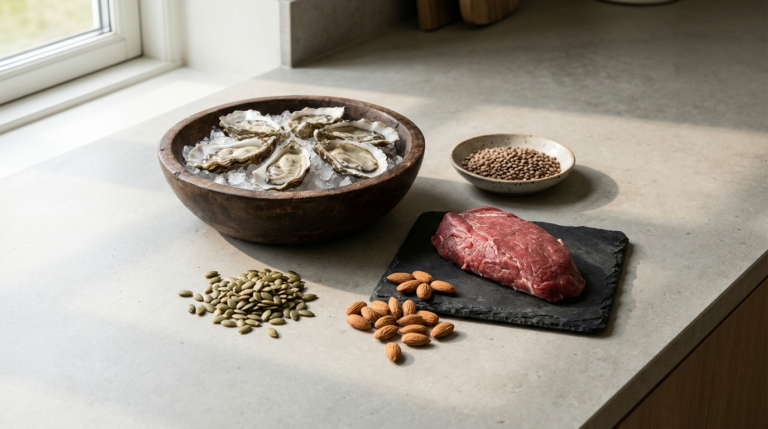

For healthy people eating a normal diet, L-carnitine’s fat-loss claims are poorly backed by science. Your body makes its own and you get plenty from meat and fish. Popping extra tablets won’t meaningfully change your fat burning or weight. That’s not what supplement jars promise, but it’s what the evidence shows.
What is L-carnitine and what does it do in your body?
L-carnitine is a compound your body makes itself from two amino acids: lysine and methionine. It’s mainly stored in your muscles and plays a key role in your energy system.
The main job: L-carnitine ferries fatty acids into your mitochondria — the tiny power plants inside your cells. That’s where fats get burned for energy. Without carnitine, those fats never reach the place where they’re supposed to be used for fuel.
Think of it this way: your fat is the fuel and your mitochondria are the engine. L-carnitine is the delivery truck bringing fuel to the engine. No truck, no fuel gets where it needs to go.
That’s where the tempting idea comes from: more L-carnitine means more delivery trucks, which means more fat reaching the engine, which means more fat burning. It sounds logical. But the human body isn’t that simple, and that’s exactly where the fat-burning claim falls apart.
Does L-carnitine actually help with weight loss and fat burning?
This is the real question, so here’s the straight answer: in healthy people getting enough carnitine already, the effect on weight loss is small to negligible.
Why doesn’t “more delivery trucks” work? Because the truck isn’t the bottleneck. Your body keeps your carnitine levels in your muscles steady regardless of whether you pop a tablet. The transport of fat to your mitochondria isn’t the step that slows down fat burning in a healthy person. Adding extra carnitine solves a problem that doesn’t exist.
Some studies show a tiny effect on body weight, mostly in overweight people on a diet. But the differences are small, the evidence is mixed and weak, and we’re talking about maybe a couple of hundred grams over weeks or months. Nothing that beats proper diet or training.
Here’s the core truth: L-carnitine isn’t a switch that turns up your fat burning. Losing weight still comes down to eating less energy than you burn. No supplement rewrites that rule.
Want to actually lose fat without losing muscle? The real wins come from eating enough protein, doing strength training, and maintaining a sensible calorie deficit. That’s where the science is solid. An L-carnitine jar doesn’t make that list.
What about performance and recovery? That’s where it gets more interesting
Beyond weight loss, L-carnitine is sometimes used for athletic performance and recovery. The evidence here is a bit stronger, though still modest.
A specific form, L-carnitine L-tartrate, has been studied for recovery after heavy weight training. There’s some indication it can slightly reduce muscle damage and soreness post-workout, possibly by improving blood flow and oxygen delivery to muscle. But we’re talking small effects, not game-changing results.
For pure endurance or strength performance (faster times, more strength, extra reps), the evidence is weak. Don’t expect to suddenly hit PRs just from taking L-carnitine.
The bottom line: for recovery, it might give a modest boost if you train hard and often. For performance itself, the effect is uncertain. It’s no substitute for solid nutrition, sleep, and smart training progression.
The different forms: L-carnitine, acetyl-L-carnitine, and L-carnitine L-tartrate
You’ll see different forms on the shelf, and they’re used for different purposes. Worth knowing which is which.
L-carnitine (or L-carnitine tartrate, the “standard” form) is what most people mean when they say L-carnitine. It’s aimed at energy and fat metabolism.
Acetyl-L-carnitine (ALCAR) crosses into the brain more easily, so it’s mostly linked to mental focus, clarity, and brain function in older adults. For sport or fat loss, ALCAR has no real advantage.
L-carnitine L-tartrate (LCLT) is the most researched form for sports recovery and muscle soreness after strength training. If you’re using it specifically for that, this is the sensible choice.
You’ll also see propionyl-L-carnitine, mostly used in medical research around blood vessels. For the average person training, it’s not relevant.
Quick summary: standard L-carnitine for energy, ALCAR for the brain, LCLT for recovery after tough training. But remember: all three only make sense if there’s a reason to supplement.
Dosing and when to take it
Research typically uses doses of roughly 1 to 3 grams per day, often split across two servings. That’s a common range, not magic numbers. Taking more doesn’t automatically mean better results — your body only absorbs so much.
One practical detail: how well you absorb L-carnitine and get it into your muscles is linked to insulin levels. That’s why some people suggest taking it with a carb-rich meal. It’s a reasonable idea if you’re using it anyway, but no need to turn it into complicated timing.
On timing: there’s no strong evidence that a specific time of day matters much. Using it for recovery (LCLT)? Take it around training or with meals, spread through the day. What matters more than perfect timing is consistency — with L-carnitine, any effects take weeks of regular use, not one dose before a workout.
Start low, see how your stomach handles it, and build up gradually if needed.
Frequently asked questions
Will L-carnitine help me burn more fat if I'm healthy and eating normally?
No. If your body already gets enough L-carnitine from food (meat, fish) and makes its own, taking extra won’t meaningfully boost fat burning. The evidence shows the effect is small to none in healthy people eating normally. Weight loss still depends on eating less than you burn.
What's the difference between L-carnitine, ALCAR, and L-carnitine L-tartrate?
Standard L-carnitine targets energy and fat metabolism. Acetyl-L-carnitine (ALCAR) is better at crossing into the brain and is used for mental focus. L-carnitine L-tartrate (LCLT) is most researched for muscle recovery after strength training. Choose based on your actual goal.
Can L-carnitine improve my athletic performance?
Not directly. For pure performance (speed, strength, endurance), the evidence is weak. L-carnitine L-tartrate might slightly reduce muscle soreness after heavy training, but don’t expect major performance gains. Good nutrition, sleep, and training progression matter far more.
How much L-carnitine should I take and when?
Research typically uses 1 to 3 grams per day, split into doses. Taking it with a carb-rich meal may help absorption. Timing isn’t critical — consistency over weeks matters more than perfect timing. Start low and build up to see how you tolerate it.
Do I need to supplement with L-carnitine?
Probably not, unless you’re a vegan (it’s mainly in meat and fish), vegetarian, or training very hard and specifically want to try L-carnitine L-tartrate for recovery. For fat loss in healthy people, there are far better ways to spend your money.
Is L-carnitine safe to take?
Yes, L-carnitine is generally safe at normal doses (1–3 grams daily). Some people report mild stomach upset or a fishy body odour. If you have kidney issues, check with a doctor first. It’s a real compound your body makes naturally, so serious side effects are rare.